USU's BLS, HIPAA and bloodborne pathogens requirements
Three training items sit on USU's clinical checklist: American Heart Association BLS for healthcare providers, the Appendix C HIPAA Confidentiality Agreement, and Bloodborne Pathogens training. The HIPAA and bloodborne items are completed in the Nursing Caring Corner in D2L, with an 80% quiz pass mark. BLS must be American Heart Association, and online-only courses don't count.
Ready on training, still missing a preceptor?
Tell us your USU course and start date. A placement advisor will reply by email.
Three items, one checklist
All three appear on the Appendix A PAC checklist (November 2025), listed as AHA CPR, Signed HIPAA Confidentiality Agreement and Proof of Blood Borne Pathogens Training. DNP students find the HIPAA and bloodborne training in the DNP Doctoral Community rather than the Nursing Caring Corner.
| Item | What USU asks for | Where it's done |
|---|---|---|
| BLS | American Heart Association BLS for the Professional Rescuer or Healthcare Provider | An AHA course; online-only isn't accepted |
| HIPAA Confidentiality Agreement | The signed agreement (Appendix C) | Nursing Caring Corner in D2L |
| Bloodborne Pathogens training | Proof of training, with a quiz score of 80% or higher | Nursing Caring Corner in D2L |
The RN-BSN, Nurse Educator and Health Care Leadership handbook also lists American Heart Association BLS, and all three USU clinical handbooks have the HIPAA Confidentiality Agreement as Appendix C.
BLS: what counts and what doesn't
USU's FNP handbook requires American Heart Association BLS certification at the Professional Rescuer or Healthcare Provider level, and it is specific about the exceptions.
- Accepted: AHA BLS for the Professional Rescuer or Healthcare Provider.
- Not accepted: online-only courses.
- Not accepted: ACLS on its own. If you hold ACLS, you still need a current BLS card.
- Possibly accepted: government or military BLS, which the handbook says may be acceptable. Confirm with your CPC before relying on it.
- Not named: other providers' courses. Both the handbook and USU's admission requirements name the American Heart Association.
Check your card's expiry date against your clinical calendar. Complio sends notices 60, 45, 30 and 15 days before an item expires, and an expired BLS card puts you on clinical pause like any other lapsed item. How those notices work is on our Complio page.
Online-only BLS and ACLS alone don't meet USU's requirement. You need American Heart Association BLS at the healthcare provider level.
The HIPAA Confidentiality Agreement (Appendix C)
The HIPAA Confidentiality Agreement is Appendix C in all three of USU's clinical handbooks: FNP, DNP, and RN-BSN/Nurse Educator/Health Care Leadership. Appendix A lists it as a signed item, so an unsigned or partly completed form won't satisfy the checklist.
You complete it in the Nursing Caring Corner, the nursing resource shell in D2L Brightspace. Keep your own copy of what you sign, so you can produce it quickly if anyone asks.
The agreement covers how you handle patient information during clinicals. Your site may have its own onboarding requirements on top of USU's, and the FNP handbook says students provide what sites ask for. Treat any site paperwork as separate from, not a replacement for, Appendix C.
Bloodborne Pathogens training and the 80% quiz
Bloodborne Pathogens training is also done in the Nursing Caring Corner, or in the DNP Doctoral Community if you're a DNP student. USU sets the pass mark at 80% or higher on the quiz.
Appendix A asks for proof of the training, so save your result when you finish. The USU pages we checked don't say how retakes work if you score below 80%, so ask your CPC rather than guessing.
Some sites ask for their own safety training in addition to USU's. The FNP handbook gives OSHA training as an example of what a site may request, alongside fingerprints and an American Heart Association Healthcare CPR lesson. Ask each site what it needs as soon as it agrees to host you.
Timing: when to do each one
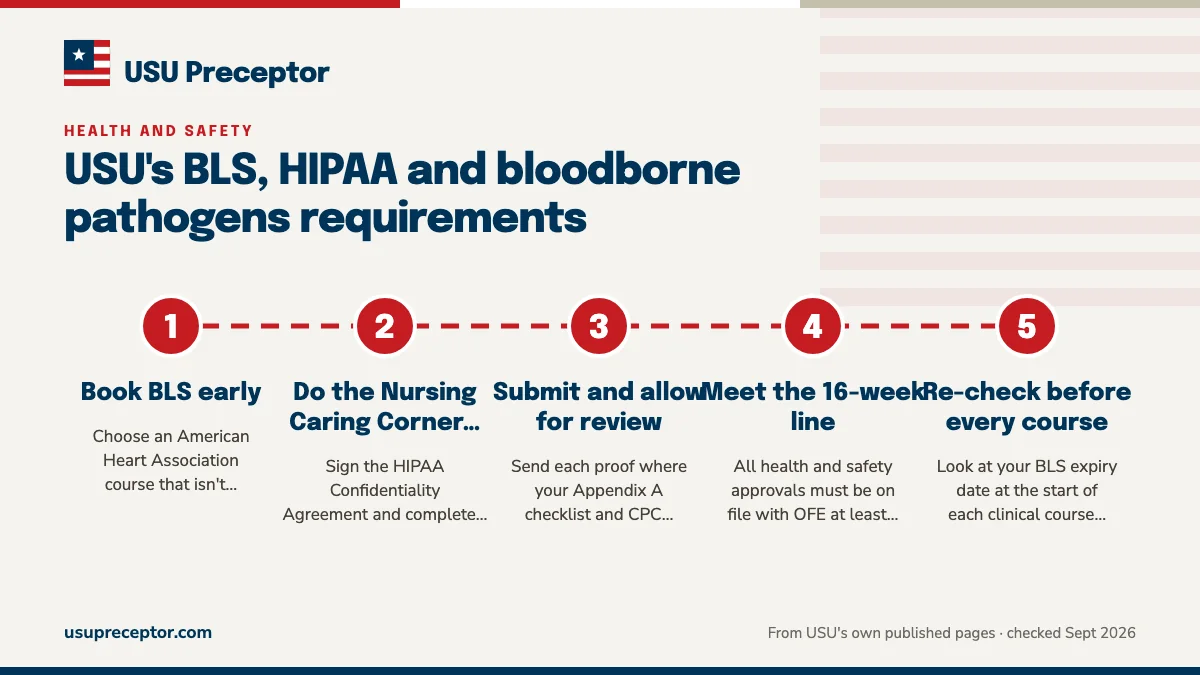
- Book BLS earlyChoose an American Heart Association course that isn't online-only, and check that the card will stay valid through your clinical courses.
- Do the Nursing Caring Corner items togetherSign the HIPAA Confidentiality Agreement and complete the Bloodborne Pathogens training and quiz in one sitting, then save your proof.
- Submit and allow for reviewSend each proof where your Appendix A checklist and CPC direct. For Complio items, review takes 2 to 5 business days, then about 2 more for OFE.
- Meet the 16-week lineAll health and safety approvals must be on file with OFE at least 16 weeks before your clinical course. Our clinical deadlines page lays out every date in order.
- Re-check before every courseLook at your BLS expiry date at the start of each clinical course, not only the first.
How these fit with the rest of your compliance file
These three training items sit alongside the immunizations, medical clearance, background check, drug screen and insurance that make up the compliance part of USU's PAC model. OFE issues your approval letter only once everything on Appendix A is approved, so a missing BLS card holds you up as surely as a missing vaccine record.
The other two parts of PAC, the Preceptor and the Agreement, run on their own clocks. Program Director approval of a preceptor takes 4 to 16 weeks on average, and a new Affiliation Agreement can take 4 to 6 months. Finishing your training items early lets you give those longer steps your full attention.
The rest of the list is covered on our health and safety requirements page and our student malpractice insurance page.
What we take off your list
These training items are yours to complete. Where we help is with the parts that usually take longer: finding a preceptor and site that fit your USU course, and gathering the preceptor documents OFE and the Program Director review. If a site asks for extra training such as OSHA, we pass that on early so it doesn't catch you out.
USU gives the final approval on every preceptor and site, and we make sure the documents behind each one are in order. Start with the request form.
Questions USU students ask
Does USU accept an online-only BLS course?
No. USU's FNP handbook says online-only courses aren't accepted. You need American Heart Association BLS at the Professional Rescuer or Healthcare Provider level. Government or military BLS may be acceptable, but confirm with your Clinical Placement Coordinator before relying on it, since the handbook stops short of saying it always counts.
Can I use my ACLS card instead of BLS for USU clinicals?
Not on its own. The handbook says ACLS alone isn't accepted, so you need a current American Heart Association BLS card as well. Check the BLS expiry date against the end of your last clinical course, since an expired card puts you on clinical pause and stops your hours until the renewal is approved.
Where do I find USU's HIPAA and bloodborne pathogens training?
In the Nursing Caring Corner, a nursing resource shell inside D2L Brightspace, according to USU's Office of Field Experience. DNP students use the DNP Doctoral Community instead. The training includes a quiz you need to pass at 80% or higher, and Appendix A asks for proof of the training and the signed HIPAA agreement.
What is Appendix C in the USU clinical handbooks?
Appendix C is the HIPAA Confidentiality Agreement. It carries that letter in the FNP, DNP and RN-BSN/Nurse Educator/Health Care Leadership handbooks alike, and USU's Appendix A checklist lists it as a signed item. Complete and sign it in the Nursing Caring Corner, and keep your own copy for your records.
Will USU accept a BLS card from a provider other than the American Heart Association?
USU's FNP handbook and admission requirements both name the American Heart Association, and the handbook doesn't list other providers. The one alternative it mentions is government or military BLS, which it says may be acceptable. If your card comes from anywhere else, ask your CPC before your deadline rather than assuming it will pass review.
Related pages
Last checked 2026-09-23
We check these pages against USU's own catalog, handbooks and disclosures. USU's current handbook and your Clinical Placement Coordinator have the final word.
Six months out is USU's rule. We start now.
Tell us your USU program, your state and when your next practicum opens. We look for preceptors who meet USU's rules and help you build the packet the Office of Field Experience and Program Director review.
- Preceptors matched to the course: family practice, pediatrics, women's health, urgent care within USU's caps
- Appendix H, license, CV and board certification gathered the way OFE asks
- In person near you; telehealth only inside USU's 40-hour limit
Start your placement plan
A placement advisor replies with what a USU-ready preceptor and site look like for you.