USU's FNP in Oklahoma: three conditions in the Board's rule
Every USU nursing program that's admitting is open to Oklahomans. For FNP students, the Oklahoma Board of Nursing's rule is specific: an RN in an out-of-state APRN program may do clinicals in Oklahoma without a Board permission step, but only if three conditions hold. One is yours to meet; two sit with USU.
Get your placement plan
Tell us your USU track and where you live. A placement advisor replies with what a USU-ready preceptor and site look like for you.
OAC 485:10-5-12(c), condition by condition
Oklahoma's rule on out-of-state programs has two tracks. For programs that lead to initial licensure, the Board must give prior permission, supported by a letter of request, an affiliation agreement and faculty supervision. RNs in out-of-state APRN programs, which is where USU's FNP students sit, skip the permission step only when all three of these hold:
- You hold an unencumbered license that lets you practice as a registered nurse in Oklahoma.
- The faculty member who oversees the clinical component has an unencumbered Oklahoma license at the level being taught or above.
- The program satisfies the APRN education requirements the Board sets.
Research for this page didn't find how USU meets the second and third conditions for Oklahoma placements, so ask your CPC before you commit to an Oklahoma site. Keep your license clean, too: an encumbrance would break the first condition and USU's own license rule at once.
Programs for Oklahoma residents
| Program | Open to Oklahoma residents? | Hours or status |
|---|---|---|
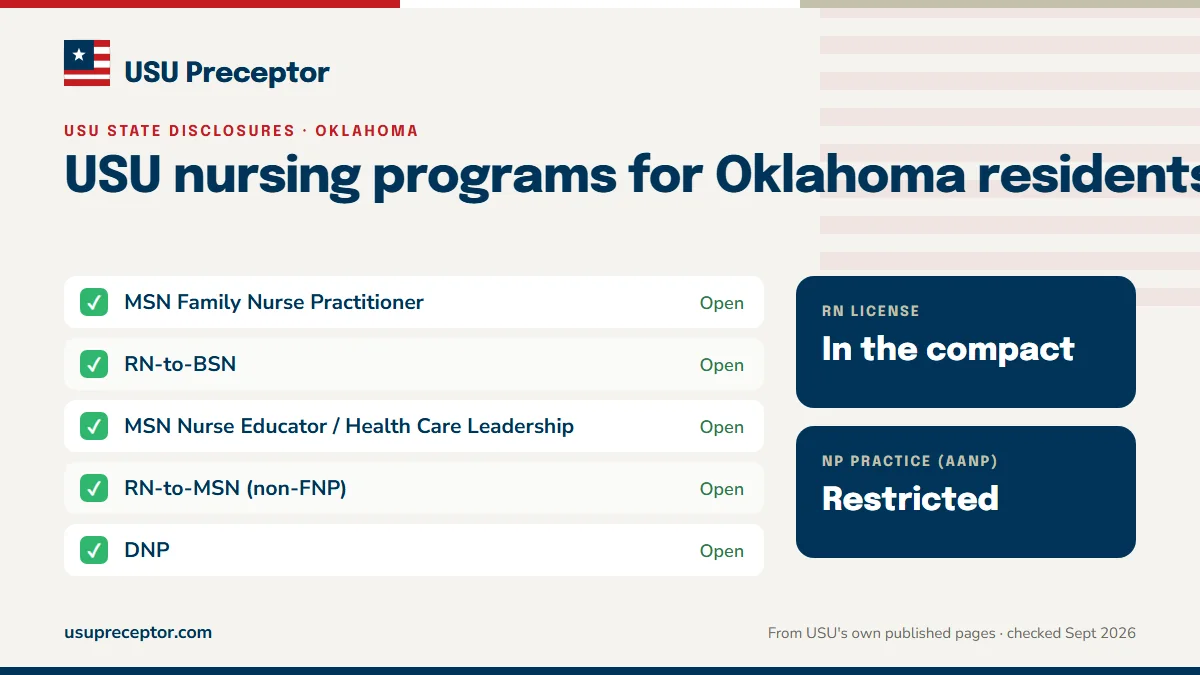
| MSN Family Nurse Practitioner | Yes | 540 across FNP592, FNP594, FNP596, FNP597 |
| MSN Nurse Educator | Yes | 100 in MSN578 |
| MSN Health Care Leadership | Yes | 100 in MSN587 |
| RN-to-BSN | Yes | 90 in NUR378 and NUR499 |
| DNP | Yes | 1,000 post-baccalaureate |
| Post-Master's FNP Certificate | No | Closed to new applicants; listed as pending with the Oklahoma board |
USU's state authorization list notes the Post-Master's FNP as pending with the Oklahoma Board of Nursing. USU stopped taking applications to the certificate in April 2024, so that note doesn't open a door for new students.
Restricted practice and who precepts
AANP classes Oklahoma as restricted. Oklahoma NPs need a written statement documenting physician supervision for prescriptive authority for 6,240 hours, and they may not prescribe Schedule II drugs. The physicians behind those arrangements are potential preceptors too, since USU accepts licensed MDs and DOs alongside board-certified NPs.
USU still wants at least 135 of your 540 hours with an NP, a year of experience from every preceptor and an active license in the clinical state. The details are on our preceptor requirements page.
Oklahoma's preceptor tax credit, and whether it reaches you
HB 3351 of 2024 created a Preceptor Tax Credit Program for Oklahoma-licensed MDs, DOs, PAs and APRNs who provide primary care in Oklahoma and precept medical students or residents, PA students or APRN students. The Oklahoma Health Care Workforce Training Commission runs it, is taking applications for 2026 and awards credits first come, first served while funds last, up to 10 rotations a year. Per the Tax Commission, the credit is nonrefundable and covers tax years 2026 through 2035.
The published program description sets no limit to Oklahoma schools. But it defines a rotation as 160 aggregate hours, more than the 135 hours in any single USU FNP course. Whether time with a USU student qualifies is for the Commission to say, so don't promise the credit to a preceptor.
Oklahoma City, Tulsa, Lawton, Enid
Census estimates for 2025 put the Oklahoma City metro at about 1.51 million people and Tulsa at about 1.07 million, with Lawton near 128,000 and Enid near 62,000. OU Health, INTEGRIS Health, Saint Francis Health System, SSM Health St. Anthony and Hillcrest HealthCare System are among the systems where Oklahoma FNP students look, not a list of USU sites.
USU expects you to travel anywhere in your state at your own expense, so from Lawton or Enid the two big metros are in play. Oklahoma implemented the Nurse Licensure Compact on January 19, 2018, but not the APRN Compact. Your compact license comes from your primary state of residence, so a resident's Oklahoma-issued license is the one the Board's rule names. See the RN license page.
Why Oklahoma students choose us
A placement advisor looks for Oklahoma preceptors who fit your USU course and helps you prepare the Appendix H packet and site details that OFE and the Program Director review. Board filings and the tax credit sit with USU and the state, which keeps our work focused on the preceptor and the packet. If a preceptor withdraws, we search again; USU approves every placement. Start an Oklahoma search.
Questions USU students ask
Does USU's FNP meet Oklahoma's APRN education requirements?
USU's state authorization disclosure says the MSN-FNP meets APRN educational requirements in the states where it is authorized, and Oklahoma is one of them. The Board's clinical rule separately asks that out-of-state programs meet its APRN education requirements. Research didn't find a Board statement about USU specifically, so confirm with your CPC before placing hours in Oklahoma.
Can I do clinicals in Texas or Kansas while living in Oklahoma?
USU encourages hours in your state of residence and can't promise another state's board will accept hours done elsewhere. Kansas is the harder case: USU doesn't offer its FNP to Kansas residents because the program falls short of Kansas's APRN clinical-hour minimum. Raise any out-of-state lead with your CPC first. See the Texas and Kansas pages.
Does Oklahoma's out-of-state rule cover the RN-to-BSN?
It doesn't address RN-to-BSN programs; its permission step covers programs leading to initial licensure, and its conditions cover APRN programs. USU's practicum handbook asks for an active license in the state of your rotation. The practicum is 90 community hours in NUR378 and NUR499 with a volunteer agency leader. See the RN-to-BSN page.
Does a multistate license from another state meet Oklahoma's APRN-student condition?
What the rule wants is an unencumbered license that permits registered nursing practice in Oklahoma, and multistate licenses from other compact states are recognized there. Whether the Board reads another state's multistate license as meeting that condition wasn't confirmed in research. It mostly matters if you've just moved, so ask your CPC.
Related pages
Last checked 2026-09-23
We check these pages against USU's own catalog, handbooks and disclosures. USU's current handbook and your Clinical Placement Coordinator have the final word.
Six months out is USU's rule. We start now.
Tell us your USU program, your state and when your next practicum opens. We look for preceptors who meet USU's rules and help you build the packet the Office of Field Experience and Program Director review.
- Preceptors matched to the course: family practice, pediatrics, women's health, urgent care within USU's caps
- Appendix H, license, CV and board certification gathered the way OFE asks
- In person near you; telehealth only inside USU's 40-hour limit
Start your placement plan
A placement advisor replies with what a USU-ready preceptor and site look like for you.