Studying nursing at USU from Wisconsin
Wisconsin residents can enroll in USU's FNP and its other admitting nursing programs. Wisconsin requires out-of-state nursing schools to be approved by its Board of Nursing, and USU's disclosure says Wisconsin lists USU as an approved out-of-state school.
Looking for a Wisconsin preceptor?
Tell us your USU course and your part of the state.
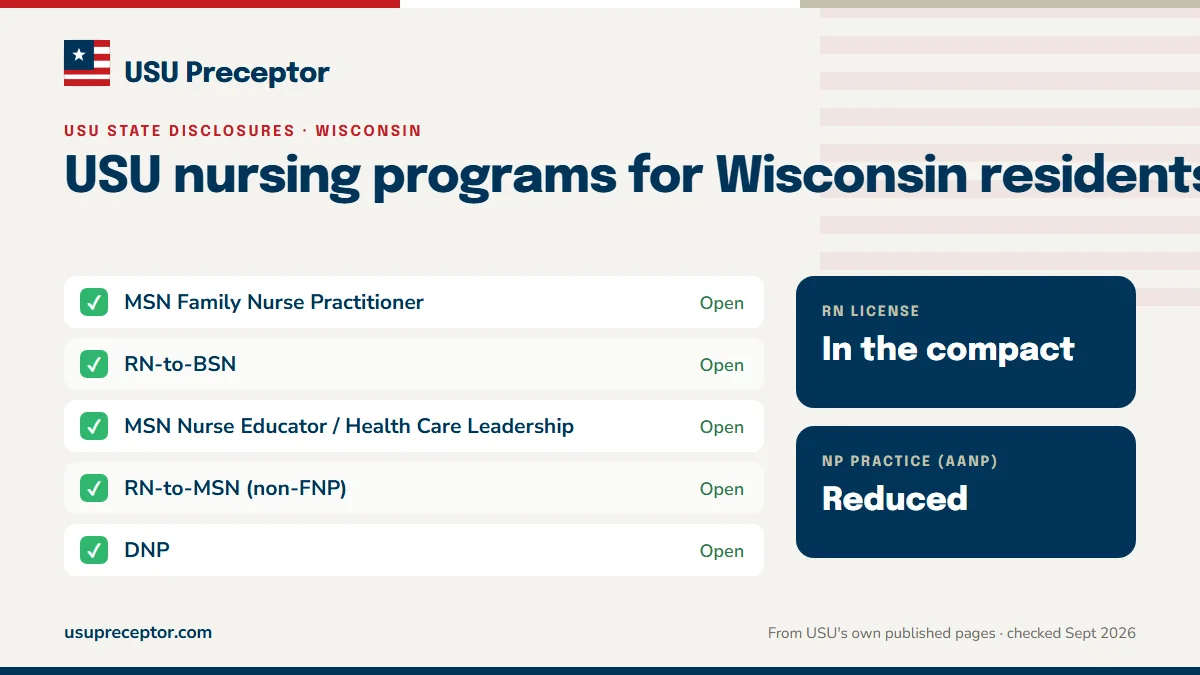
Where Wisconsin residents stand at USU
No USU nursing program that's admitting excludes Wisconsin. Here's each one with the clinical time you'll need to place.
| USU program | Wisconsin | Clinical hours |
|---|---|---|
| Family Nurse Practitioner (MSN) | Open | 540, split evenly over FNP592, FNP594, FNP596 and FNP597 |
| Nurse Educator (MSN) | Open | 100, MSN578 |
| Health Care Leadership (MSN) | Open | 100, MSN587 |
| RN-to-BSN | Open | 90 over two courses |
| DNP | Open | 1,000 post-baccalaureate; not currently CCNE-accredited |
Wisconsin's approval rule names post-licensure bachelor's programs, which matters if you're heading into the RN-to-BSN and its community practicum. The next section covers what USU's Wisconsin listing tells you and what to confirm.
Wisconsin's approval rule, and USU's listing
Wisconsin is one of the states that asks for approval. According to DSPS Form 3067-OEE (revised April 13, 2026), approval requirements for out-of-state schools of nursing come from Wis. Admin. Code N 1.06, and those schools need the Wisconsin Board of Nursing's approval. Practical nurse and RN programs at associate, bachelor's and graduate level all fall under the form, which names post-licensure bachelor's programs specifically. To keep their approval, approved schools then submit a self-evaluation report on Form 3069OEE.
USU's Board of Nursing disclosure says Wisconsin lists USU as an “Approved Out-of-State Nursing School.” Wisconsin's list names schools, not programs. If you're in a program other than the FNP, confirm with your CPC that the approval covers it, or check the list the Department of Safety and Professional Services publishes.
Wisconsin also requires faculty and preceptors for clinicals in the state to be licensed in Wisconsin or to hold the privilege to practice there. Check your preceptor's before the Appendix H goes in.
A new APRN law, in force since September 1
September 1, 2026 was the effective date of 2025 Wisconsin Act 17. APRN licenses from DSPS now come in four roles, certified nurse-midwife, clinical nurse specialist, CRNA and nurse practitioner, and existing APNP licenses have been converted to APRN. Practicing without a collaborating physician takes a separate application and Board approval.
The AANP still lists Wisconsin as reduced practice, with NPs in a collaborative relationship with a physician, and notes the new law's effective date. For your search, expect an NP preceptor's license to read APRN rather than APNP. What USU looks for is set by its FNP handbook, not the license title: national board certification for NPs, physicians as the alternative, a year's experience at minimum, and 135 or more of your hours with an NP. See preceptor requirements.
Compact licensing, with Minnesota next door
Wisconsin's Nurse Licensure Compact membership dates to January 19, 2018, so a Wisconsin multistate license reaches other compact states. Minnesota isn't one of them. The Minneapolis-St. Paul and Duluth metros both spill into Wisconsin, and a clinic on the Minnesota side would need a Minnesota license, because USU wants you licensed wherever your clinicals take place.
USU would also rather your hours stay in Wisconsin, your approved state of residence; its disclosure warns that hours logged in another state may not be accepted by a licensing board. Telehealth follows the same line, since telehealth patients have to be located in your state on file. More on out-of-state clinicals.
Milwaukee, Madison, Green Bay, Appleton
Milwaukee-Waukesha is Wisconsin's biggest metro at about 1.58 million people, followed by Madison (about 710,000), Green Bay (about 337,000) and Appleton (about 250,000). Large systems include Aurora Health Care, part of Advocate Health; Froedtert ThedaCare Health, the Froedtert and Medical College of Wisconsin network; UW Health; Ascension Wisconsin; and Aspirus Health.
These show where FNP students search, not where USU holds agreements, so check with your CPC. Hospital units are out, since USU never counts inpatient hours; clinics and outpatient offices are where your 540 hours happen.
What we do for Wisconsin students
Our search covers Wisconsin NPs and physicians in settings your USU course accepts; we check that each holds a Wisconsin license or privilege to practice, and help you get the preceptor paperwork ready for USU. Whether a preceptor or site is approved is USU's call alone, and if a preceptor steps away, we search again. Tell us your course.
Questions USU students ask
Is USU approved by the Wisconsin Board of Nursing?
According to USU's Board of Nursing disclosure, Wisconsin lists it as an approved out-of-state nursing school, a status Wisconsin requires under Wis. Admin. Code N 1.06. Approved schools must also file self-evaluation reports to keep that status. To see the current list yourself, open the approved out-of-state schools document on the DSPS website, linked in the sources below.
Does Wisconsin's approval cover USU's RN-to-BSN?
Wisconsin's approval rule reaches post-licensure bachelor's programs as well as graduate ones, so the RN-to-BSN falls within its scope. The listing USU cites is for the school as an approved out-of-state nursing school, so confirm with your CPC that it covers you before your NUR378 practicum. You'll also need an active nursing license for the state where the practicum happens.
I live in western Wisconsin. Can I do clinicals in the Twin Cities?
You can ask, but Minnesota is a non-compact state, so a Wisconsin multistate license doesn't cover it and you'd need a Minnesota license. USU also prefers clinicals in your state of residence, and a Wisconsin site spares you a second license altogether.
Does Wisconsin's new APRN law change what my preceptor needs?
Mostly the paperwork. Since September 1, 2026, Wisconsin NPs hold APRN licenses in place of APNP licenses, so the license you verify in the Appendix H packet should be the current APRN record. Your preceptor still needs an active Wisconsin license or privilege to practice in the state.
Related pages
Last checked 2026-09-23
We check these pages against USU's own catalog, handbooks and disclosures. USU's current handbook and your Clinical Placement Coordinator have the final word.
Six months out is USU's rule. We start now.
Tell us your USU program, your state and when your next practicum opens. We look for preceptors who meet USU's rules and help you build the packet the Office of Field Experience and Program Director review.
- Preceptors matched to the course: family practice, pediatrics, women's health, urgent care within USU's caps
- Appendix H, license, CV and board certification gathered the way OFE asks
- In person near you; telehealth only inside USU's 40-hour limit
Start your placement plan
A placement advisor replies with what a USU-ready preceptor and site look like for you.