Maryland: USU doesn't enroll residents in any nursing program
USU's disclosures say the Maryland Board of Nursing requires formal approval that USU has not obtained, so USU doesn't enroll Maryland residents in the FNP, the RN-to-BSN, its other MSNs or the DNP. Here is what that means if you live in Maryland, plan to move there, or study with USU from a neighboring state.
A USU student near the Maryland line?
Tell us your course and the state you live in.
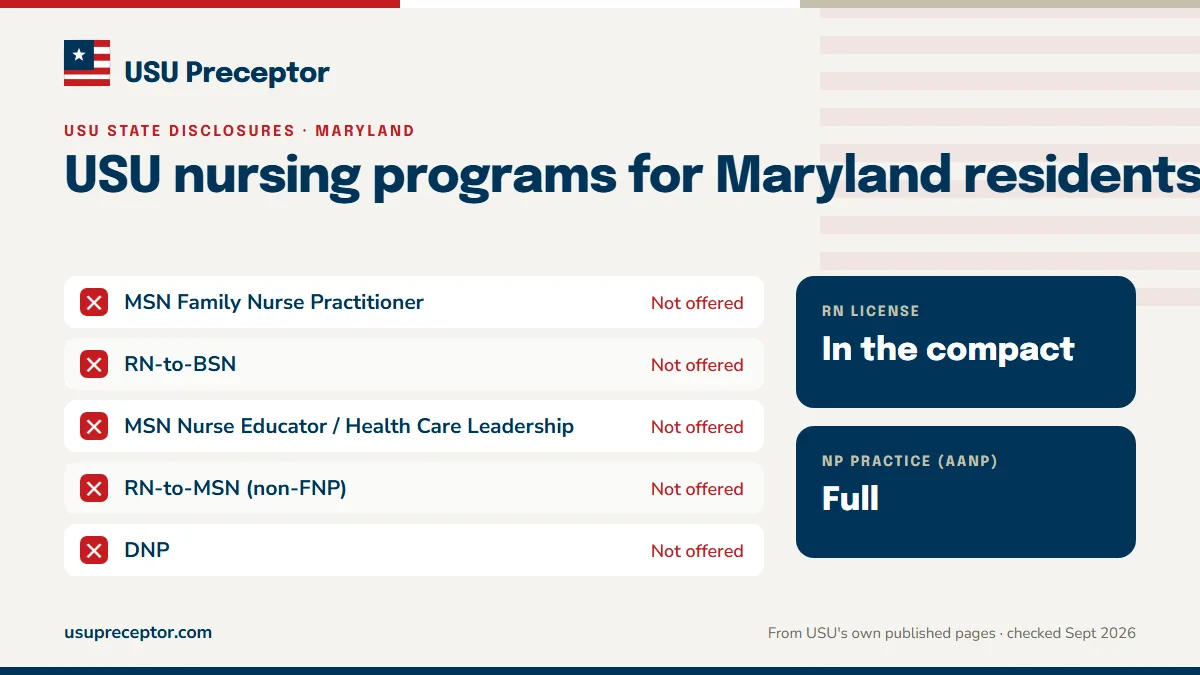
USU nursing programs: Maryland against its neighbors
| Program | Maryland | District of Columbia | Delaware, Pennsylvania, Virginia, West Virginia |
|---|---|---|---|
| MSN Family Nurse Practitioner (540 h) | No | No | Yes |
| MSN Nurse Educator or Health Care Leadership (100 h) | No | No | Yes |
| RN-to-BSN (90 h) | No | No | Yes |
| DNP (1,000 post-baccalaureate h) | No | No | Yes |
Maryland and DC are the only places on USU's lists, apart from two territories, where every nursing program is closed. Residence is what counts, since USU's policy bars enrolling people who reside where it lacks authorization. A job in Arlington or Wilmington doesn't change the answer for a Maryland resident.
Why: a Board of Nursing approval USU doesn't hold
USU's Board of Nursing and State Authorization disclosures give one reason for Maryland: formal approval by the Maryland Board of Nursing (MBON) is required and has not been obtained. That's USU's account, and it's the only one we rely on.
It isn't a general distance-education problem. Schools from other states must register with the Maryland Higher Education Commission before enrolling Marylanders online, unless they are approved to participate in SARA, as USU is. The gap sits with the nursing board.
MBON also says it must review and approve every NP program before certifying its graduates as advanced practice nurses, and that the school, not the applicant, submits the Program Approval Form when a program isn't listed. That makes the board's approved-program list the thing to check before counting on any out-of-state NP degree in Maryland.
Moving to Maryland during or after USU
USU's catalog says that if you move to a state where your program isn't offered, you can't complete it, and for Maryland that covers every nursing program. The FNP handbook and USU's State Relocation Notice carry the same warning. If a family move to the Baltimore area is coming, talk to your Clinical Placement Coordinator before the date is fixed.
Moving after graduation raises a licensing question instead. USU's licensure disclosure is blunt: in states where the FNP isn't authorized, Maryland among them, it does not meet educational requirements for APRN licensure. Before planning NP certification in Maryland on a USU degree, check MBON's approved NP programs.
Studying with USU from Virginia, Pennsylvania or West Virginia
About 2.5 million Marylanders live in the Washington metro and another 158,000 in the Hagerstown-Martinsburg area, which crosses into West Virginia, so many USU students live a short drive from Maryland sites. USU encourages clinicals in your state of residence and considers other states only where it's approved for your program. Maryland isn't approved for any, and neither is DC.
In practice, a Virginia FNP student in Alexandria should build a preceptor list on the Virginia side, and a Pennsylvania student in the Harrisburg area should look to Pennsylvania practices, not Baltimore ones. Our out-of-state clinicals page has the full rule.
Maryland's board, compact and practice rules
Maryland implemented the Nurse Licensure Compact on January 19, 2018; under COMAR 10.27.01.03(B), a nurse with a multistate privilege may practice there under Maryland law. It hasn't enacted the APRN Compact. Maryland is full practice in AANP's classes; NPs must declare 18 months of mentorship with a physician or certified NP.
Maryland also offers an NP Preceptorship Tax Credit: NPs and physicians qualify by precepting NP students unpaid in Board-approved preceptorships and completing a minimum of three community-based rotations, each 90 hours or longer, in workforce shortage areas. Luminis Health, LifeBridge Health, MedStar Health, the University of Maryland Medical System and Johns Hopkins Medicine are among its large systems.
Why students near Maryland choose us
USU doesn't enroll Maryland residents in nursing, so our work around Maryland serves USU students who live next door. If you're a USU student in a neighboring state, a placement advisor searches your own state for a preceptor or site that fits your course and USU's rules, and prepares a complete file for USU's final approval. Tell us where you live.
Questions USU students ask
Can I take USU's RN-to-BSN if I live in Maryland?
No. USU's lists exclude Maryland for the RN-to-BSN as well as the FNP, the other MSN tracks, the RN-to-MSN and the DNP, all for the same stated reason: Maryland Board of Nursing approval is required and hasn't been obtained. USU's accreditation page links the current lists if you want to check for changes.
I live in Maryland but work in Virginia. Can I enroll using my work address?
No. USU's enrollment rule turns on where you reside, not where you work. Your address on file also decides where telehealth patients must be and where USU expects your clinicals. Enrolling on an address where you don't live isn't a workaround.
Does Maryland's NP preceptor tax credit apply to USU students?
The credit is written for unpaid preceptorships of NP students in Board-approved preceptorships, within programs the Maryland Board recognizes, and the preceptor must complete at least three qualifying rotations. USU says it hasn't obtained Maryland Board approval and doesn't enroll Maryland residents, so USU students aren't the group the credit was designed around.
Can a USU FNP student in Delaware do clinical hours in Maryland?
Not as USU describes its rules. Out-of-state requests are possible only into states where USU is approved for your program, Maryland is approved for none, and USU prefers home-state hours anyway. A Delaware student should plan around Delaware sites, where USU's filing obligations to the Delaware Board also apply.
Related pages
Last checked 2026-09-23
We check these pages against USU's own catalog, handbooks and disclosures. USU's current handbook and your Clinical Placement Coordinator have the final word.
Six months out is USU's rule. We start now.
Tell us your USU program, your state and when your next practicum opens. We look for preceptors who meet USU's rules and help you build the packet the Office of Field Experience and Program Director review.
- Preceptors matched to the course: family practice, pediatrics, women's health, urgent care within USU's caps
- Appendix H, license, CV and board certification gathered the way OFE asks
- In person near you; telehealth only inside USU's 40-hour limit
Start your placement plan
A placement advisor replies with what a USU-ready preceptor and site look like for you.