Pennsylvania residents in USU's FNP: what the state adds to your clinicals
Every USU nursing program is open to Pennsylvania residents. We found no Pennsylvania Board of Nursing approval step for out-of-state programs placing students there, so your placement turns on USU's approvals, your license and Pennsylvania's collaborative model for NPs.
Need a Pennsylvania preceptor for a USU course?
Tell us your course, your term and your county or city.
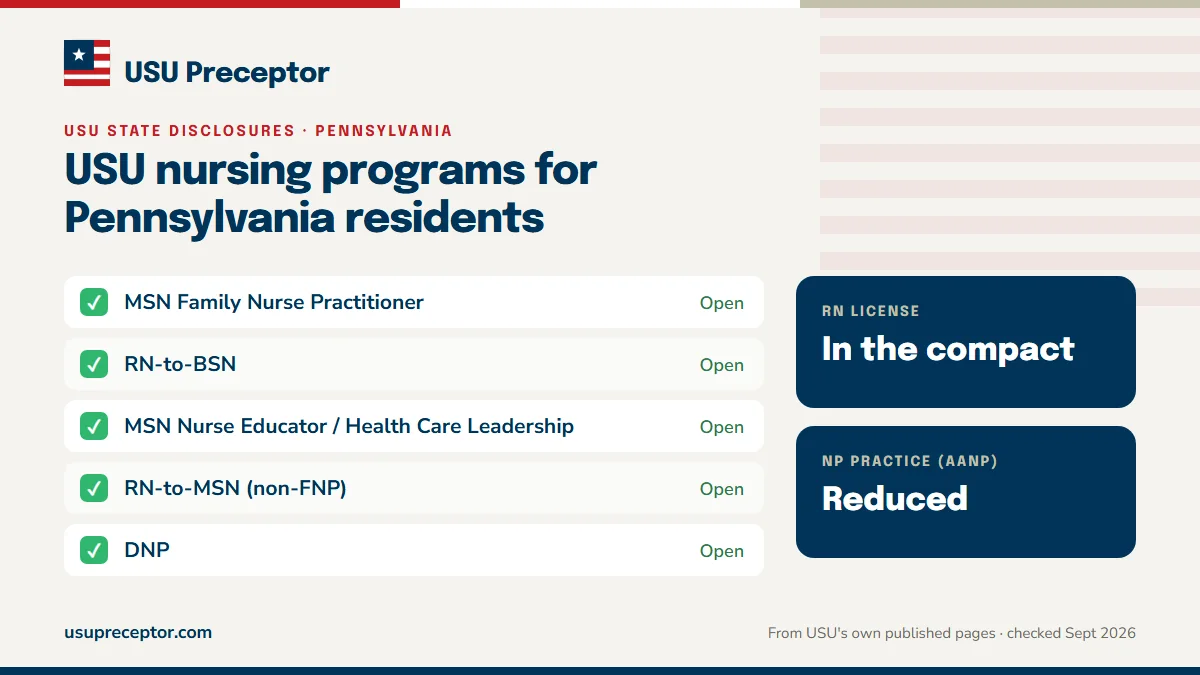
USU programs a Pennsylvania resident can take
| Program | Open to Pennsylvania residents? | Clinical or practicum hours |
|---|---|---|
| MSN Family Nurse Practitioner | Yes | 540: FNP592, FNP594, FNP596, FNP597, 135 each |
| MSN Nurse Educator | Yes | 100 in MSN578 |
| MSN Health Care Leadership | Yes | 100 in MSN587 |
| RN-to-BSN | Yes | 90 in NUR378 and NUR499 |
| DNP (post-master's) | Yes | 1,000 post-baccalaureate |
USU's catalog notes that its MSN and BSN are CCNE-accredited, while its disclosure says the DNP currently isn't. That detail matters for one Pennsylvania rule below. For course-by-course FNP detail, see our FNP preceptor page.
No published approval step for out-of-state programs
We found no regulation or guidance from the Pennsylvania State Board of Nursing that makes out-of-state or distance programs obtain approval before they place students in Pennsylvania clinicals. Only programs the Board itself approves use its Distance Education Application.
That leaves USU's own gates: your preceptor through Program Director review, the site through an Affiliation Agreement that USU's Office of Field Experience sends, and an OFE Approval Letter before any hours. The placement process page lays out that sequence.
One change is in motion. Final-form delivery of IRRC #16A-5141, the Board's comprehensive rulemaking on nursing education programs, came on September 8, 2026, and the Independent Regulatory Review Commission has a meeting set for October 15, 2026. In that final text, the student-license rule described below stays substantially the same.
Your license: a new compact state with a student rule
Pennsylvania implemented the Nurse Licensure Compact on July 7, 2025, so an active, unencumbered multistate license now covers practice there. It hasn't enacted the APRN Compact.
There is also a Pennsylvania student exemption, at 49 Pa. Code 21.118. It lets an RN who holds a license from another US jurisdiction or Canada and is enrolled in an accredited BSN or graduate program practice without a Pennsylvania license in the clinical settings the program requires, as long as any pay is limited to stipends, scholarships or program awards. Employment as an RN in the state while you're in the program is another matter, requiring a temporary practice permit and licensure by endorsement.
Two cautions. USU's own rule is stricter, requiring an active license in your state on file and wherever you do clinicals. And the exemption names accredited programs, which is why the DNP's accreditation status is worth raising with your CPC before relying on it. Our RN license page covers the USU side.
Collaborative agreements and your preceptors
AANP classes Pennsylvania as reduced practice. For their whole career, NPs maintain a written agreement with physicians, and they need collaborative agreements with two or more physicians for prescriptive authority. The NP who precepts you will be working inside that arrangement.
For USU, your preceptor can be a board-certified NP or a licensed MD or DO employed by the site, with at least 135 of your 540 hours under an NP. A certified nurse-midwife counts only for women's health hours, and physician assistants aren't on USU's list at all. Each preceptor needs a Pennsylvania license and their employer's permission to precept.
Where Pennsylvania FNP students look, and lines not to cross
Penn State Health, Geisinger, Jefferson Health, Penn Medicine and UPMC are among Pennsylvania's large systems, spread across four big metros: Philadelphia (about 4.2 million Pennsylvanians), Pittsburgh (2.4 million), Allentown-Bethlehem-Easton and Harrisburg-Carlisle. They're examples of where students search, not sites set aside for USU. Inpatient hours never count, so aim for outpatient and primary care practices.
The Philadelphia metro spills into New Jersey, Delaware and Maryland, and each is different for USU. New Jersey is approved, but USU's ratio there is one student per preceptor. Delaware requires USU to notify its Board before a site is used. Maryland is closed to every USU nursing program, and to the north, New York is closed to the FNP. USU prefers home-state hours in any case.
Why Pennsylvania students choose us
A placement advisor searches your region of Pennsylvania for an NP or physician preceptor and an outpatient site that fit your USU course, helps you assemble what USU's Office of Field Experience and Program Director review, and searches again if a preceptor pulls out. Approval stays with USU. Tell us your course and county.
Questions USU students ask
Can I keep working as an RN in Pennsylvania on the student exemption?
No. 49 Pa. Code 21.118 covers only the unpaid clinical practice your program requires. For RN employment in the state while you're enrolled, the rule points to a temporary practice permit plus licensure by endorsement, and since July 2025 an active multistate license from a compact state also covers practice there.
Can a physician assistant precept my USU FNP hours in Pennsylvania?
No. USU's FNP handbook lists board-certified NPs, licensed MDs and DOs, and certified nurse-midwives for women's health hours only. Physician assistants aren't listed. Hours precepted by a PA won't count, however closely they work with your NP preceptor, so make sure the person signing your Appendix H Preceptor Information and Acknowledgement Form is an eligible preceptor.
I live near the New York border. Can I do USU FNP hours in New York?
No. New York is closed to USU's FNP, and USU only considers out-of-state requests where it's approved for your program. New York's education department also warns that NP clinical rotations there for students in programs it hasn't registered could be illegal. Plan on Pennsylvania sites; our New York page has the detail.
Will Pennsylvania's new nursing education regulations change my USU clinicals?
Nothing published so far points that way. The rulemaking (IRRC #16A-5141) reached final form on September 8, 2026, with a review meeting set for October 15, 2026, and it keeps the student-license rule in substantially the same form. If the final rule adds anything for out-of-state programs, USU's Office of Field Experience would be the one to tell you.
Related pages
Last checked 2026-09-23
We check these pages against USU's own catalog, handbooks and disclosures. USU's current handbook and your Clinical Placement Coordinator have the final word.
Six months out is USU's rule. We start now.
Tell us your USU program, your state and when your next practicum opens. We look for preceptors who meet USU's rules and help you build the packet the Office of Field Experience and Program Director review.
- Preceptors matched to the course: family practice, pediatrics, women's health, urgent care within USU's caps
- Appendix H, license, CV and board certification gathered the way OFE asks
- In person near you; telehealth only inside USU's 40-hour limit
Start your placement plan
A placement advisor replies with what a USU-ready preceptor and site look like for you.