Colorado: every current USU nursing program is open
USU's disclosures don't exclude Colorado from any of its current nursing programs, so the FNP, Nurse Educator, Health Care Leadership, RN-to-BSN and DNP are all available. Colorado's board rules on program approval are written for pre-licensure schools, and we found no separate approval step for an out-of-state graduate program's clinicals. The work is in the search itself, from Denver to Colorado Springs, Greeley and Fort Collins.
Get your placement plan
Tell us your USU track and where you live. A placement advisor replies with what a USU-ready preceptor and site look like for you.
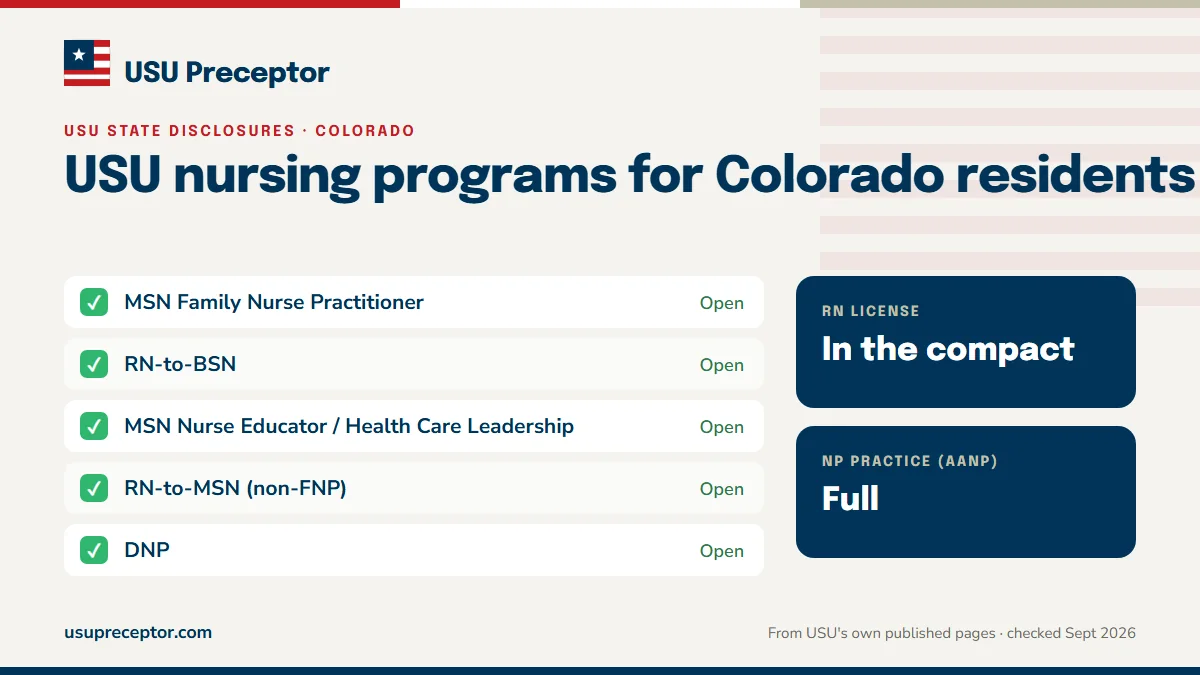
USU programs for Colorado residents
Colorado doesn't appear on any of USU's exclusion lists for its current nursing programs. Only the Post-Master's FNP certificate is out of reach, and that's true in every state since it stopped accepting applications in April 2024.
| Program | Open in Colorado? | Clinical or practice hours |
|---|---|---|
| Family Nurse Practitioner (MSN) | Yes | 540 in four practicums, FNP592 through FNP597 |
| Nurse Educator (MSN) | Yes | 100 during MSN578 |
| Health Care Leadership (MSN) | Yes | 100 during MSN587 |
| RN-to-BSN | Yes | 90 community hours |
| DNP | Yes; not currently CCNE-accredited | 1,000 post-baccalaureate, as many as 500 carried in |
What Colorado's Board of Nursing asks of out-of-state programs
On the rule text, very little. Under 3 CCR 716-1, Rule 1.2, the Colorado State Board of Nursing's rule on program approval, a nursing education program means a basic course of study that leads to first-time RN or LPN licensure. The rule doesn't require RN-to-BSN or graduate programs based in other states to seek approval before placing students in Colorado, or even to give notice. This reading rests on the rule text alone, since the Board's own website was unavailable for checking any further guidance, so treat it as a starting point rather than the last word.
You may come across Colorado's student permit. The permit is for students and graduates of nontraditional programs based out of state that lack a faculty-supervised clinical component, when they need hours in Colorado to qualify for licensure. It isn't a general clinical-placement permit for a program like USU's, where your hours run under a preceptor with USU faculty oversight.
The 750-hour mentorship and your preceptor search
Colorado is full practice in AANP's rating, with one condition: before gaining prescriptive authority, an NP has to attest to 750 hours of experience under an agreement with an APRN mentor or a physician. When you approach a recently certified NP, ask where they stand; USU wants at least a year of experience at or above your licensure level, current national board certification for an NP, and an active, unencumbered Colorado license.
Plan for at least 135 hours with an NP, and remember USU's ratio: no more than two students per preceptor, other schools' NP students included. The full list is on our preceptor requirements page.
Preceptors who take no compensation and teach in rural or frontier shortage areas are rewarded by the state's Rural and Frontier Health Care Preceptor Tax Credit. Since HB22-1005 it has been limited to precepting students at an accredited Colorado college or university, so it doesn't appear to cover a USU student. Don't offer it to a preceptor as a reason to take you.
Denver, Colorado Springs, Greeley, Fort Collins
Denver-Aurora-Centennial is the state's largest metro, some 3.09 million people as of the 2025 Census estimates, followed by Colorado Springs (about 782,000), Greeley and Fort Collins-Loveland. Denver Health, UCHealth, HCA HealthONE, CommonSpirit Health and Intermountain Health, which operates Saint Joseph Hospital in Denver, are among the state's systems. They're examples of where Colorado FNP students look, not places lined up for USU. Because USU never counts inpatient hours, it's their outpatient primary care clinics that matter to you.
USU's catalog expects you to go anywhere in Colorado for a placement at your own expense. Line up at least three preceptor leads for each Interest Form six months before the practicum.
Licensing: compact yes, APRN Compact no
Colorado's Nurse Licensure Compact membership dates to January 19, 2018. The APRN Compact isn't law there. For Colorado clinicals USU needs your RN license active, unencumbered and valid in Colorado, with your liability insurance written for the same state; our RN license page explains how compact licenses fit. If Colorado is your state on file, telehealth patients must be in Colorado, for no more than 40 FNP hours.
Why Colorado students choose us
A placement advisor searches Colorado for NPs and physicians whose outpatient practice fits your USU course, and helps you prepare the Appendix H packet for OFE and the Program Director. USU approves or declines each one. If a preceptor backs out, we search again. Share your course and city.
Questions USU students ask
Is USU's DNP an option for Colorado residents?
Yes. Colorado isn't among the DNP exclusions, which take in Idaho, Utah, Washington and New York among others. Expect 1,000 practice hours beyond the bachelor's, of which as many as 500 may transfer, guided by a Project Mentor with a doctorate. USU discloses that the DNP isn't currently CCNE-accredited, so weigh that before applying; the DNP page has more.
Can I do USU clinicals in Cheyenne or Santa Fe from Colorado?
Colorado sites come first. USU's disclosure asks students to complete hours in their approved state of residence and won't promise that hours logged elsewhere will satisfy a licensing board. A Wyoming or New Mexico site would also need your RN license to be valid there, and Wyoming's board wants written notice from the program before clinicals start. Raise it with your CPC early.
Do hours at a Denver hospital count toward USU's FNP?
Not if they're inpatient. USU never approves inpatient or hospital settings for FNP hours, and urgent care is capped at 135 of the 540. Your opening rotation, FNP592, has to sit in family practice, primary care or internal medicine primary care. A hospital system's outpatient clinics are where the usable hours are.
Does my multistate license cover Colorado clinicals?
Colorado is a compact state, and USU asks for an active, unencumbered license valid wherever you do clinicals and in your state on file. USU's rules don't address compact privileges directly, so confirm with your Clinical Placement Coordinator that your license is accepted before OFE reviews your compliance file.
Related pages
Last checked 2026-09-23
We check these pages against USU's own catalog, handbooks and disclosures. USU's current handbook and your Clinical Placement Coordinator have the final word.
Six months out is USU's rule. We start now.
Tell us your USU program, your state and when your next practicum opens. We look for preceptors who meet USU's rules and help you build the packet the Office of Field Experience and Program Director review.
- Preceptors matched to the course: family practice, pediatrics, women's health, urgent care within USU's caps
- Appendix H, license, CV and board certification gathered the way OFE asks
- In person near you; telehealth only inside USU's 40-hour limit
Start your placement plan
A placement advisor replies with what a USU-ready preceptor and site look like for you.