Alaska: USU FNP students register their own preceptorship
An Alaska address keeps all of USU's admitting nursing programs open to you. What sets Alaska apart is who files: the Alaska Board of Nursing registers each student in an out-of-state APRN program individually, rather than approving the program. Alaska is also outside the Nurse Licensure Compact, so you'll need an Alaska RN license.
Get your placement plan
Tell us your USU track and where you live. A placement advisor replies with what a USU-ready preceptor and site look like for you.
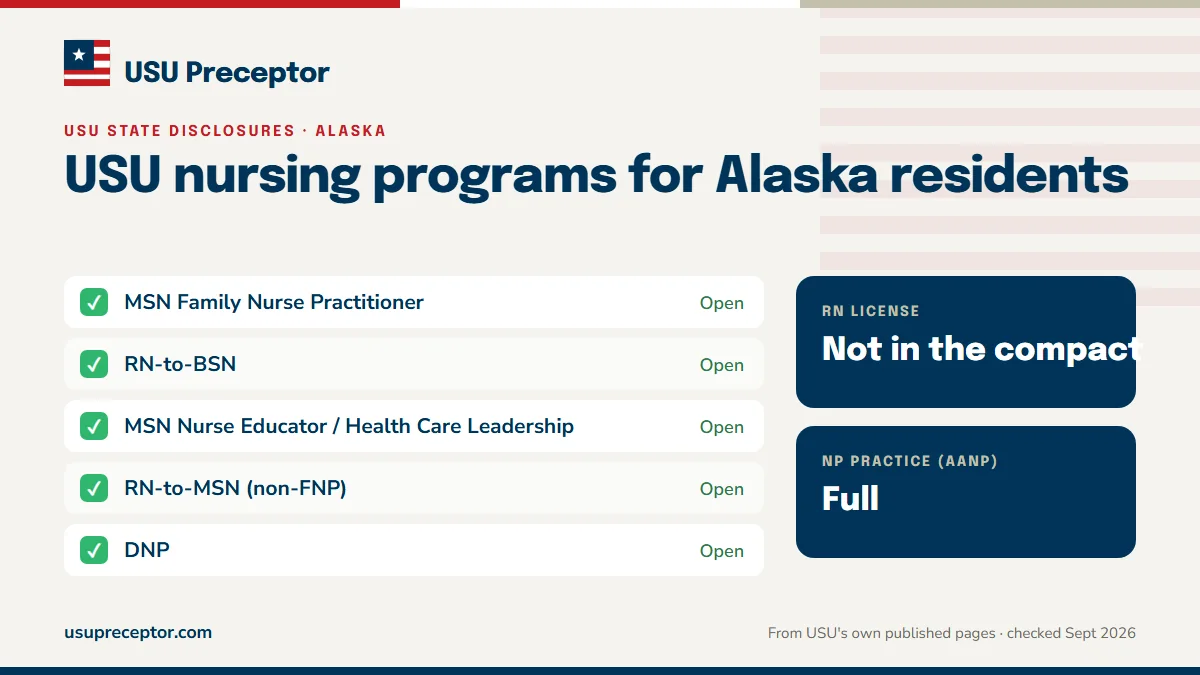
USU programs open to Alaskans
| Program | Open to Alaska residents? | Clinical hours |
|---|---|---|
| MSN Family Nurse Practitioner | Yes | 540 (FNP592, FNP594, FNP596, FNP597) |
| MSN Nurse Educator | Yes | 100 |
| MSN Health Care Leadership | Yes | 100 |
| RN-to-BSN | Yes | 90 |
| DNP | Yes | 1,000 post-baccalaureate |
USU's exclusion lists don't name Alaska for any admitting program; only the closed Post-Master's FNP certificate is off the table.
The APRN Preceptorship Registration, step by step
Alaska's Board of Nursing FAQ tells APRN students they have to file a preceptorship application with the Board. 12 AAC 44.460 is the rule behind it: the Board registers the applicant to do clinical practice as part of an APRN course of study run from outside Alaska. You file it on form 08-4253 and pay a non-refundable fee; it registers you personally and does not approve USU.
- Line up the preceptorshipThe application needs a Board-approved preceptorship arrangement, shown by a copy of the agreement among the school, the facility, you and your preceptor. Ask your CPC which USU document serves that purpose; a new site's affiliation agreement can take four to six months.
- Gather your proofHave proof that you're currently enrolled in an APRN program, plus a good-standing RN license issued by Alaska or any other state.
- File form 08-4253Submit the APRN Preceptorship Registration to the Board with its fee.
- Watch the clockIt lapses at 12 months or at the end of the preceptorship, if that comes sooner, and you may renew it one time.
Four 8-week practicums can stretch past a year if there are gaps between them; that's when the single renewal matters. Because a registration also ends with the preceptorship, ask the Board how a change of preceptor between courses affects yours.
Alaska's registration is your filing, not USU's. Build it into your timeline alongside USU's own approvals.
Who can precept an APRN student in Alaska
The Board's form sets its preceptor standard: an active, unencumbered license or privilege to practice as an APRN or physician, a comparable practice focus, and the job of supervising, teaching and evaluating you on site. USU's rules sit on top: a board-certified NP or licensed MD or DO with a year of experience, at least 135 of your 540 hours with an NP and no more than two students at once. See preceptor requirements.
AANP lists Alaska as a full practice state, so NP-led clinics are worth approaching. The Board also expects out-of-state faculty to hold an Alaska RN license once their clinical grading and other nursing education in Alaska pass 20 working days in a licensing period. That one is USU's to manage.
Anchorage, Fairbanks, Juneau and Palmer
Census estimates for 2025 put the Anchorage metro at about 406,000 people, Fairbanks-College at about 94,000 and the Juneau micro area at about 32,000. FNP students in Alaska tend to look at Foundation Health Partners in Fairbanks, which has Fairbanks Memorial Hospital and Tanana Valley Clinic; Mat-Su Regional Medical Center in Palmer; HCA's Alaska Regional Hospital; Anchorage's tribal health system, the Alaska Native Medical Center; and Providence Alaska Medical Center, operated by the largest hospital operator in the state. Listing them doesn't mean they work with USU.
USU never counts inpatient hours, so the outpatient clinics behind these names are what matter. USU also expects you to travel anywhere in your state at your own expense, a rule to weigh carefully in Alaska.
Licensing: an Alaska license, no compact
Alaska isn't in the Nurse Licensure Compact. The Board's compact page says the legislature hasn't passed legislation to join and describes HB 131 and SB 124, from the 2025-2026 session, as pending. Alaska hasn't enacted the APRN Compact either.
The Board's registration accepts an RN license from Alaska or another state, but USU is stricter for residents. It wants an RN license in the state where you live and an active, unencumbered license wherever you train, so an Alaska resident needs an Alaska license. See RN license for clinicals.
Why Alaska students choose us
A placement advisor searches Alaska for preceptors who meet both USU's criteria and the Board's standard, and helps you assemble the packet OFE and the Program Director review. You file the Board registration yourself. If a preceptor drops, we search again; USU approves every placement. Ask about an Alaska search.
Questions USU students ask
Does the RN-to-BSN practicum need an Alaska Board registration?
The Board's FAQ sets two conditions for RN-to-BS students: a current, unencumbered RN license from any US state or territory, and enrollment in a nursing program that is nationally accredited and approved by the state where it is located. No registration step is stated. USU adds an active license in the state of your 90-hour practicum. See the RN-to-BSN page.
Can telehealth ease the distances in Alaska?
Within limits: USU caps telehealth at 40 FNP hours, with approval. Patients have to be located in Alaska, where your address is on file, and you need to be licensed there. Your preceptor has to be physically with you and video is required; teleprecepting from another location isn't approved. See virtual clinical options.
Can an Alaska physician precept me?
Yes, under both sets of rules. Alaska's preceptor standard names APRNs and physicians, and USU accepts licensed MDs and DOs with a year of experience. But USU requires at least 135 of your 540 hours with an NP, so a physician can't carry the whole program.
Is USU still authorized to enroll Alaska residents?
USU's Board of Nursing list, updated May 2026, doesn't exclude Alaska for any admitting program. Its state authorization disclosure shows an Alaska 'valid till' date of October 2025, which has passed. If you're weighing enrollment, ask USU admissions or your CPC to confirm Alaska's current status.
Related pages
Last checked 2026-09-23
We check these pages against USU's own catalog, handbooks and disclosures. USU's current handbook and your Clinical Placement Coordinator have the final word.
Six months out is USU's rule. We start now.
Tell us your USU program, your state and when your next practicum opens. We look for preceptors who meet USU's rules and help you build the packet the Office of Field Experience and Program Director review.
- Preceptors matched to the course: family practice, pediatrics, women's health, urgent care within USU's caps
- Appendix H, license, CV and board certification gathered the way OFE asks
- In person near you; telehealth only inside USU's 40-hour limit
Start your placement plan
A placement advisor replies with what a USU-ready preceptor and site look like for you.