Finishing a closed USU MSN track: your practicum hours and preceptors
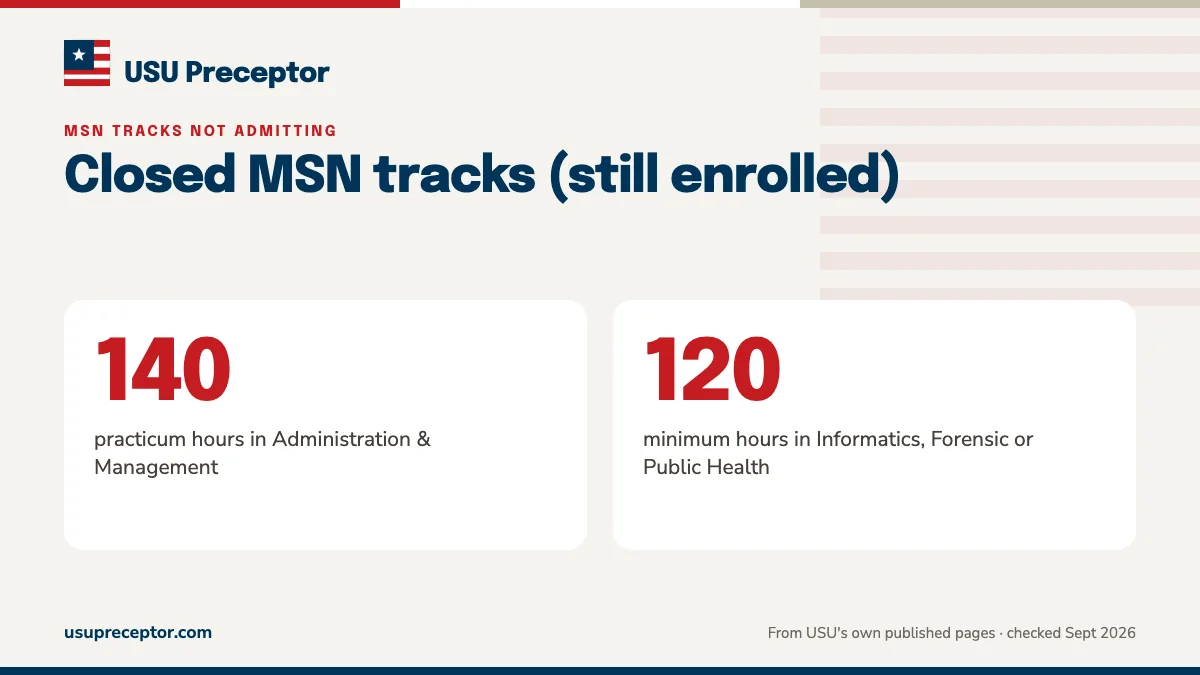
USU's catalog lists four MSN concentrations as not accepting applicants: Administration & Management, Informatics, Forensic Nursing and Public Health. If you're still enrolled in one, your practicum is 140 hours across two courses in Administration, or at least 120 hours in a single course in the other three, with the preceptor type each course description names.
Find a preceptor for your practicum
Tell us your track, your practicum course and where you live. A placement advisor replies with what a USU-ready preceptor for that course looks like near you.
What "not accepting applicants" means for you
The 2026-2027 catalog still lists all four concentrations, each at 35 credits and 24 months, but marks them as not accepting applicants. USU's time-to-completion policy gives these tracks a 60-month limit, so the date you started matters as much as the date you plan to finish.
Unlike the closed Post-Master's FNP certificate, which had a published cutoff for enrolled students, we found no teach-out end date for these four tracks in USU's sources. Only your advisor can tell you whether, and when, each remaining course in your track will run.
That question matters most for the practicum, because hours you don't finish are lost and must be redone in the following term. In a track that isn't admitting, confirm that your practicum course will actually be offered in the term you need, and in the term after, before you commit a preceptor to dates.
Practicum courses by track
These come from the catalog's MSN page and course descriptions. The preceptor column is what each course description names; the USU clinical handbooks we reviewed don't add detail for these tracks.
| Track | Practicum course | Hours | Preceptor the course names |
|---|---|---|---|
| Administration & Management | MSN559 Nursing Administration Practicum I (3 credits) | 40 | Not specified; the catalog says practicum experiences are designed and arranged by the student, with faculty approval |
| Administration & Management | MSN595 Administration and Management Nursing Practicum II (3 credits, after MSN559) | 100 | Nurse executive preceptor |
| Informatics | MSN598 Informatics Nursing Practicum (3 credits) | 120 minimum | Master's-prepared informatics nurse |
| Forensic Nursing | MSN597 Forensic Nursing Practicum (3 credits) | 120 minimum, 20 or more in direct care | Master's-prepared nurse |
| Public Health | MSN594 Public Health Nursing Practicum (3 credits) | 120 minimum, 20 or more in direct care | Master's-prepared nurse |
Administration & Management is the only track with two practicums, and MSN595 can't start until MSN559 is complete, so its 140 hours have to be planned as a sequence. The totals for every USU program sit side by side on USU clinical hours by program.
Direct care in Forensic Nursing and Public Health
Forensic Nursing and Public Health each require at least 20 direct-care hours inside their 120. The catalog doesn't define what the other 100 must be, but the direct-care minimum shapes the site you choose: somewhere you can spend part of your time with patients or clients, not only on program or policy work.
Both tracks also list MSN553 Advanced Health and Physical Assessment Across the Lifespan, MSN570 Advanced Pathophysiology and MSN571 Advanced Pharmacology among their required courses. Informatics has no direct-care minimum in its course description.
If you're unsure whether a planned activity counts as direct care, ask your course faculty before the practicum starts, in writing, and keep the answer. It is much easier to adjust a plan than to repeat hours.
MSN597 and MSN594 each need at least 20 direct-care hours. Choose a site that can provide them.
Course numbers that look like FNP courses
USU reuses the same three digits across prefixes, and it causes real confusion when you search the catalog or write to OFE. Three of your practicum numbers have FNP namesakes that are entirely different courses:
MSN594Public Health Nursing Practicum is notFNP594, the FNP acute care practicum.MSN595Administration and Management Nursing Practicum II is notFNP595, a didactic FNP course on chronic care.MSN597Forensic Nursing Practicum is notFNP597, the FNP clinical residency.
Always write the prefix. Anything you read about 135-hour practicums, NP preceptors or Appendix I settings belongs to the FNP courses and doesn't apply to your track. When you email OFE or your CPC, put the full course number and title in the subject line, so the request isn't read as an FNP question.
Which rules govern your practicum
USU's published sources are thinner for these tracks than for any other. The preceptor details come from course descriptions only. The practicum handbook USU publishes covers the RN-to-BSN, Nurse Educator and Health Care Leadership, and the OFE web page lists the programs it supports without naming these four tracks.
What clearly does apply is the catalog's college-wide field experience policy, which covers each clinical course. Three qualified preceptor names, each with working contact information, are due 6 months before the course; hours have to begin in its first week; in-state travel may be required; and unfinished hours are lost.
For everything else, including which forms you use, whether a 16-week paperwork deadline applies and how hours are logged, ask your Clinical Placement Coordinator which handbook governs your course. Ask early, since the answer changes your timeline.
States, licenses and moving
These tracks fall under USU's non-FNP MSN, which is closed to residents of Maryland and DC and of USU's two excluded territories. Washington appears as excluded on the Board of Nursing list but not on the state authorization list. A move matters most: under the catalog, relocating somewhere your program isn't offered means you can't complete it, so talk to USU before you move.
For the practicum, USU encourages clinical hours in your state of residence. USU's handbooks for its other programs ask for an active RN license in the state where clinical hours happen, so plan on the same and confirm it with your CPC. The rules on crossing state lines are on clinicals outside your state.
Why closed-track students choose us
Preceptors for these tracks can be hard to find locally: a nurse executive willing to take a student for 100 hours, a master's-prepared informatics nurse, or a master's-prepared nurse in a forensic or public health setting with direct-care time to offer.
If someone you already know fits the course description, we can focus on the paperwork alone. With the course and term confirmed by your advisor, we search near you for people who match the course description, check each one's degree, license and any personal or reporting tie to you, and help you gather what OFE asks for. USU approves every preceptor, site and agreement. For MSN559, the catalog leaves the design of your practicum experiences to you and your faculty, and we focus on the people and places. Tell us your track and course in the form below.
Questions USU students ask
Can I still finish USU's MSN in Informatics, Forensic Nursing or Public Health?
USU's catalog says it is not admitting new students to these tracks. It doesn't say enrolled students can't finish, and we found no published teach-out end date. The practical limits are USU's 60-month time-to-completion rule for these tracks and whether your remaining courses, including the practicum, are scheduled. Your advisor can confirm both.
Is USU's MSN594 the same course as FNP594?
No. MSN594 is the Public Health Nursing Practicum, at least 120 hours with a master's-prepared nurse preceptor and 20 or more hours of direct care. FNP594 is an FNP practicum of 135 hours in acute primary care. The same confusion arises with MSN595 and FNP595, and with MSN597 and FNP597.
Does USU's Informatics practicum require direct patient care?
The catalog description of MSN598 Informatics Nursing Practicum sets a minimum of 120 hours with a master's-prepared informatics nurse preceptor and gives no direct-care minimum. That differs from Forensic Nursing and Public Health, where at least 20 of the 120 hours must be direct care. Confirm any specific activity with your course faculty.
Who can precept USU's Administration and Management practicums?
The catalog names a nurse executive preceptor for MSN595, the 100-hour Practicum II. For MSN559, the 40-hour Practicum I, it describes practicum experiences designed and arranged by the student and approved by faculty, without naming a preceptor type. Ask your course faculty what they expect before you approach anyone.
What if my closed-track practicum isn't finished by the end of the course?
USU's field experience policy treats unfinished clinical hours as forfeited, and you repeat them the next term. In a track that isn't admitting, first confirm with your advisor that the course runs again when you need it, then check your 60-month time-to-completion date. Tell your preceptor early if the schedule might slip.
Related pages
Last checked 2026-09-23
We check these pages against USU's own catalog, handbooks and disclosures. USU's current handbook and your Clinical Placement Coordinator have the final word.
Six months out is USU's rule. We start now.
Tell us your USU program, your state and when your next practicum opens. We look for preceptors who meet USU's rules and help you build the packet the Office of Field Experience and Program Director review.
- Preceptors matched to the course: family practice, pediatrics, women's health, urgent care within USU's caps
- Appendix H, license, CV and board certification gathered the way OFE asks
- In person near you; telehealth only inside USU's 40-hour limit
Start your placement plan
A placement advisor replies with what a USU-ready preceptor and site look like for you.