Vermont residents at USU: the FNP is open, and Vermont sets its own preceptor standard
Vermont residents can enroll in USU's FNP and its other current nursing programs; only a non-clinical business certificate is off the list. Vermont's Board of Nursing adds a preceptor standard for APRN students, and its rules don't clearly say how out-of-state programs' clinicals fit, so a couple of questions belong with your Clinical Placement Coordinator early.
Looking for a Vermont preceptor for USU?
Tell us your course, your term and your town.
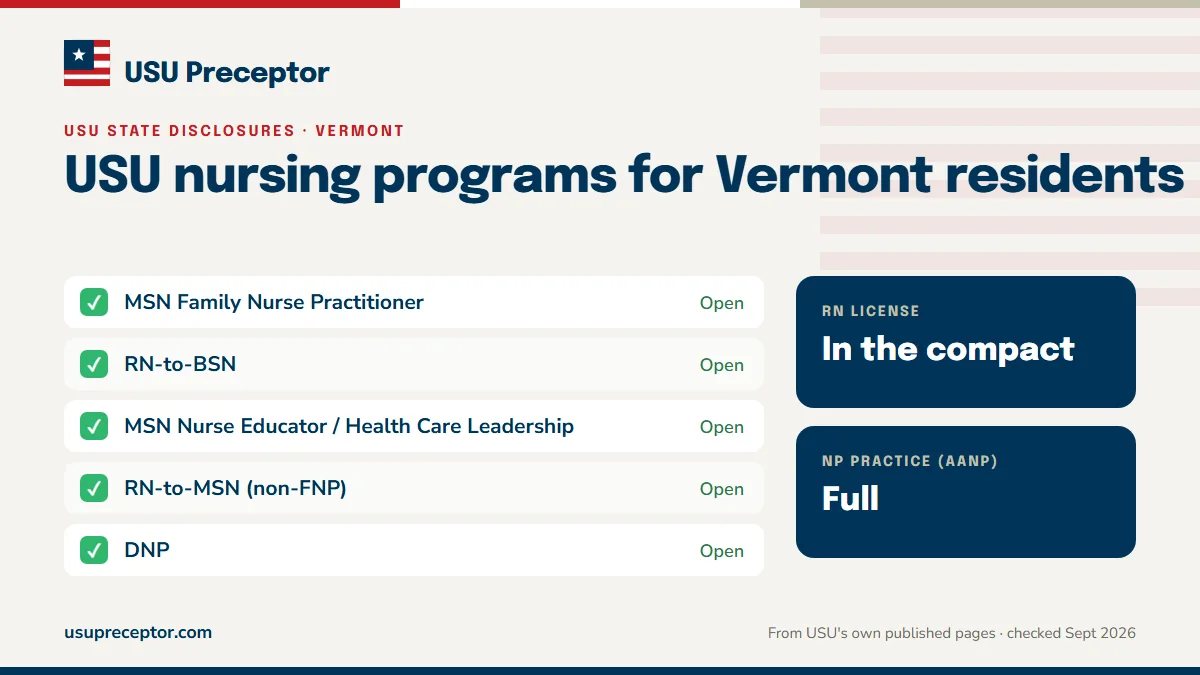
What Vermont residents can and can't take at USU
| USU offering | Vermont residents | Clinical hours |
|---|---|---|
| MSN Family Nurse Practitioner | Open | 540 in FNP592, FNP594, FNP596 and FNP597 |
| MSN Nurse Educator | Open | 100 in MSN578 |
| MSN Health Care Leadership | Open | 100 in MSN587 |
| RN-to-BSN | Open | 90 in NUR378 and NUR499 |
| DNP (post-master's) | Open | 1,000 post-baccalaureate |
| Post-Baccalaureate Certificate in Nursing Business | Not offered | None; it's a non-clinical certificate |
The certificate exclusion comes from USU's State Authorization disclosure and doesn't touch the FNP. USU's Board of Nursing list doesn't single Vermont out for any clinical filing either. FNP course detail is in our FNP guide.
Vermont's own preceptor standard
The Vermont Board of Nursing's FAQ says an APRN student's preceptor may be an APRN or a physician with an active, unencumbered Vermont license and experience in the same role and population focus, working directly with the program's faculty. Physician assistants may not precept APRN students in Vermont, which matches USU: its list covers board-certified NPs and licensed MDs and DOs, with certified nurse-midwives for women's health hours only.
The phrase to watch is same role and population focus. USU's guidance allows, for example, a PNP in a pediatrician's office for pediatric hours, or an AGNP for FNP592. Vermont's sources leave open whether it reads its standard that narrowly for an FNP student, so raise it with your Clinical Placement Coordinator before nominating a non-FNP preceptor. USU's full criteria are on preceptor requirements.
AANP classes Vermont as full practice, though NPs with fewer than 24 months and 2,400 hours of practice need a collaborating agreement with a Vermont-licensed physician or APRN.
Out-of-state programs: Vermont's rules don't say
Vermont's Board rules, in effect since May 11, 2023, require Board approval for anyone to conduct a nursing education program there; the exception is online-only programs that the Vermont Agency of Education has approved (see also 26 V.S.A. 1584). We found no rule, FAQ or statute addressing specifically the case of a program from another state placing students at clinical sites in Vermont.
Under 26 V.S.A. 1583(2), the student exemption from licensure reaches practice that is incidental to study in programs the Board has approved; it doesn't address how that applies to a licensed RN in an NP program based out of state. USU's disclosures list no Vermont filing. Ask your CPC whether USU treats Vermont placements differently; the approvals you'll see are USU's own, outlined in the placement process.
Burlington, Rutland and the New Hampshire border
Vermont's one metro area, Burlington-South Burlington, has about 228,000 people, alongside micropolitan areas around Rutland (60,000) and Lebanon-Claremont, whose Vermont side holds about 87,000. FNP students look at Southwestern Vermont Medical Center, which belongs to Dartmouth Health, a New Hampshire-based system; Rutland Regional Medical Center; and University of Vermont Health, with Porter Medical Center, Central Vermont Medical Center and UVM Medical Center. Treat them as places students commonly look, not sites with a USU arrangement, and remember that inpatient hours never count.
Most of Lebanon-Claremont lies in New Hampshire, a state where USU's FNP has no approval, so its sites can't host your hours; stay on the Vermont side. Vermont did fund preceptor incentive grants under Act 183 of 2022, but only for fiscal year 2023, only for nurses at Vermont critical access hospitals and only for students in Vermont programs. We found nothing showing the grants continued.
Licensing in a compact state since 2022
The Nurse Licensure Compact took effect in Vermont on February 1, 2022; the APRN Compact has not been enacted there. Board Rule 4.1 lets a nurse who holds an active multistate license issued by another compact state practice without a Vermont license, as long as Vermont doesn't become their primary state of residence.
USU's own rule sits alongside Vermont's: keep your license active and unencumbered in Vermont and in any other state you'd train in, with liability coverage in force there. Telehealth patients must be in Vermont, for up to 40 hours in total. See RN license for clinicals.
How we help Vermont students
We search Vermont practices for a preceptor who meets both USU's criteria and the Board's same-role standard, and help you prepare the paperwork USU's Office of Field Experience checks, from Appendix H to site details. If a preceptor pulls out mid-course, we look again. USU approves every placement. Send your course and town.
Questions USU students ask
Can a physician assistant precept my USU FNP hours in Vermont?
No, on two counts. Vermont's Board says PAs may not precept APRN students, and USU's FNP handbook doesn't list PAs as eligible preceptors. USU's accepted preceptors are board-certified NPs and physicians with an MD or DO license, plus nurse-midwives for women's health hours, and an NP has to supervise at least 135 hours.
Can I do USU clinicals in Lebanon, New Hampshire?
Not in the FNP. New Hampshire requires Board approval for out-of-state APRN programs, USU hasn't obtained it, and USU only considers out-of-state clinicals in states where it's approved. The Lebanon-Claremont area has a Vermont side, and sites there are where to search. Our New Hampshire page explains the closure.
Does Vermont's preceptor incentive apply to my USU preceptor?
Unlikely. Act 183 of 2022 funded one-time grants for fiscal year 2023, limited to nurses at Vermont critical access hospitals precepting students in Vermont nursing programs. USU isn't a Vermont program, and we found no source showing the grants continued. USU offers its own benefits to preceptors, described on our page for clinicians who precept USU students.
I'm moving to Vermont. Do I need a Vermont RN license?
Yes, as soon as you make Vermont your primary state of residence: Board Rule 4.1 says a multistate license from another compact state covers you only until your primary residence changes to Vermont. Tell USU early, too: its FNP handbook treats a move as a risk to progress, and USU doesn't take on finding you a placement if you move once a term is under way.
Related pages
Last checked 2026-09-23
We check these pages against USU's own catalog, handbooks and disclosures. USU's current handbook and your Clinical Placement Coordinator have the final word.
Six months out is USU's rule. We start now.
Tell us your USU program, your state and when your next practicum opens. We look for preceptors who meet USU's rules and help you build the packet the Office of Field Experience and Program Director review.
- Preceptors matched to the course: family practice, pediatrics, women's health, urgent care within USU's caps
- Appendix H, license, CV and board certification gathered the way OFE asks
- In person near you; telehealth only inside USU's 40-hour limit
Start your placement plan
A placement advisor replies with what a USU-ready preceptor and site look like for you.