Finding your own preceptor, OFE placement support or hiring help
USU makes you responsible for finding your clinical placements, with its Office of Field Experience (OFE) as partner and backstop. Hiring a placement service is a third route, one that puts a dedicated search built around USU's rules behind you. Whichever route you take, the same USU rules, deadlines and approvals apply, and you stay responsible for meeting them.
Get your placement plan
Tell us your USU track and where you live. A placement advisor replies with what a USU-ready preceptor and site look like for you.
Three routes, one approval process
USU's 2026-27 catalog is direct about who does the work: “Students are responsible for identifying clinical placements and preceptors.” The same passage asks you to actively partner with OFE, which steps in to help if your preferred placements fall through.
How a lead is found doesn't change what happens next. Every preceptor goes through the same packet and Program Director review, every site needs an affiliation agreement with USU, your Complio items must be clear, and nothing counts before OFE's approval letter. The clinical placement process sets out that path. The routes differ in who searches, how much choice you keep and what you owe.
The three routes side by side
| Finding your own | OFE placement support | Hiring help | |
|---|---|---|---|
| Who searches | You: your workplace, contacts and local practices | OFE, once your preferred placements don't work out | An outside service, usually alongside your own search |
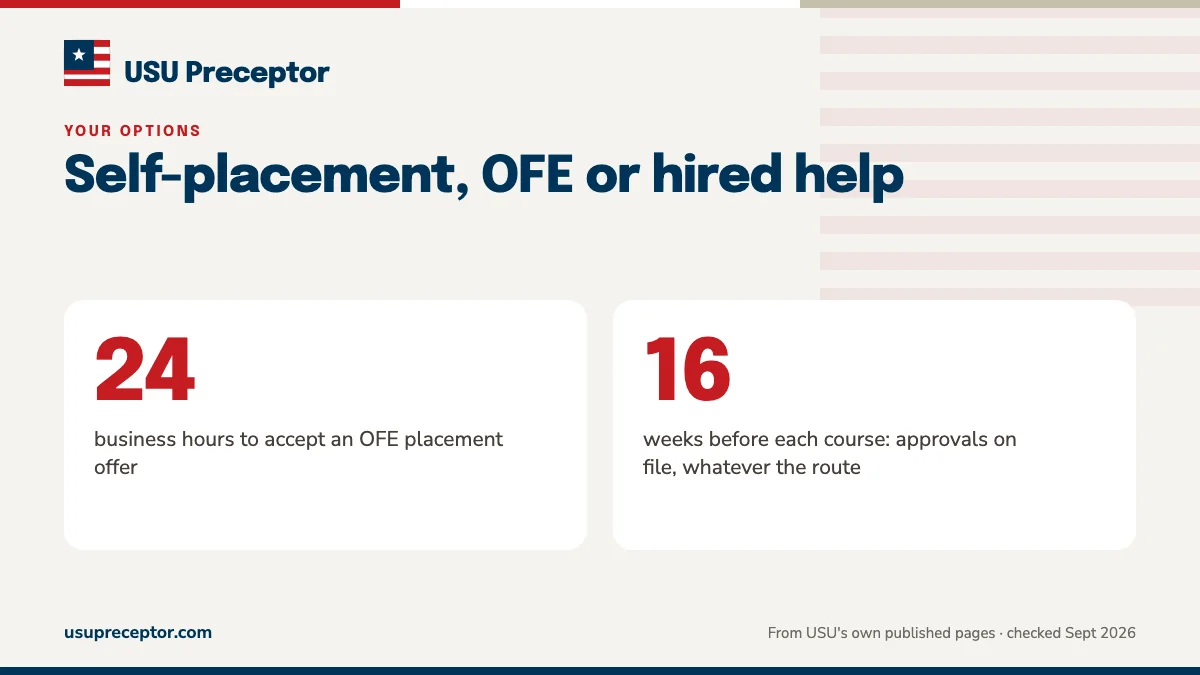
| Your deadlines | 3 qualified preceptors 6 months before each course; approvals on file 16 weeks before | The same; on-time documents and Complio earn priority | The same; you pass USU's requirements to the service |
| Choice of site | Yours | OFE offers one; accept within 24 business hours or place yourself | Yours: you decide whether to pursue each lead |
| Travel | Your decision, within USU's state rules | Anywhere in your state, at your own expense | Whatever your written terms cover |
| What you pay | Your time | Part of your USU program; the catalog fee tables list no placement charge | A quoted fee, set out in written terms before you commit |
| Who approves | USU | USU | USU, with the service preparing a complete packet |
| If it falls through | Back to your list, with OFE as backstop | OFE makes every reasonable attempt; withdraw-and-retake is possible | Your written terms set out the replacement search; tell your CPC too |
Finding your own preceptor
Self-placement gives you the most control. You choose the clinic, the commute and a preceptor whose schedule fits your job, and you can start conversations as early as you like. Many students start with their own employer, which USU allows for FNP clinicals provided you tell your CPC and clinical instructor in writing, log clinical hours apart from your regular duties and take no pay for them.
The price is effort and uncertainty. Busy clinicians often say no, and a willing one still has to meet USU's criteria: the right credential, a year of experience, a license in your clinical state and room under the two-student limit. Listing your leads on the Interest Form early keeps OFE informed and protects your priority. If your list has run dry, see can't find a preceptor.
OFE placement support: strengths and rules
OFE is a genuine resource. You have a dedicated Clinical Placement Coordinator (CPC), USU describes a nationwide network of affiliated sites and preceptors, and a site in that network may already have a signed agreement, which removes one of the longest waits. When your own leads fail, the catalog commits OFE to every reasonable attempt to place you in your area.
That help runs on OFE's terms:
- On-time students come first: priority goes to those whose documents and Complio items met the deadline.
- Same-day or urgent requests can't be handled.
- You may be placed anywhere in your state, and travel time isn't accepted as a reason to decline.
- Declining an offer, or not accepting within 24 business hours, means placing yourself for that rotation.
- Accepting means completing every hour, or facing a Code of Conduct referral.
The OFE placement support page covers each rule in full.
Hiring help: what it adds, and what stays with USU
USU acknowledges that some students work with a preceptor, site or placement service, and its catalog asks any student who does to pass USU's requirements along to it. A dedicated service adds what self-placement most often lacks: time, reach and a check of every lead against USU's criteria before it reaches you.
For a student who hires help, USU's process stays the same:
- A preceptor the service finds completes Appendix H and goes through the same Program Director review as any other, with the same outcomes possible.
- The site still needs USU's affiliation agreement, which OFE handles directly with the site.
- Your deadlines, compliance items and the approval-letter rule don't change.
- You submit the paperwork and log the hours, and you answer to USU for both.
- What the service owes you, including a replacement search, is set out in your written terms.
Using more than one route
The routes aren't exclusive, and a combined plan is often the safest: your own leads and the Interest Form first, a service if you want a wider search, OFE as the backstop. A few habits keep that from backfiring.
- Don't accept an OFE offer while you're waiting on another lead for the same course, because accepting commits you to every hour there.
- Leave agreement contact with a site to OFE. USU tells students to stay out of that process unless OFE asks them to step in.
- Keep your CPC informed, from your USU email, about each preceptor you're pursuing.
- Hold every lead to the same test: does it fit the course, the setting rules and your state?
Why USU students choose us
We're specialists in USU's clinical process. We search for a preceptor and site that fit your USU course and USU's rules, then help you assemble what OFE and the Program Director review: Appendix H, license verification, CV, board certification and site details for the agreement. You submit it, and USU makes its decision on a file that arrives complete. Should a preceptor drop out, we start a new search.
Before you commit, you receive a written quote and terms. The cost page explains what shapes a quote, and how it works follows USU's order step by step. To see the standard we hold ourselves to, read what the best USU placement service does.
Questions USU students ask
Does USU let students use a paid placement service?
USU's documents acknowledge that some students do, and the catalog says a student who uses one must pass USU's requirements along to it. Any preceptor or site found that way goes through USU's usual review: the same Program Director decision and affiliation agreement as every other route.
Can I still get OFE's help if I also use a service?
USU's published rules don't say that using a service ends OFE's help. The situations USU does name are a Code of Conduct violation, clinical probation, a jeopardized placement, refusing health and safety requirements, leaving a preceptor for fit reasons and certain moves. Keep your CPC informed and ask them directly if you're unsure.
What if my own lead comes through after I accept an OFE placement?
Under the catalog, accepting an OFE placement commits you to finishing all of its hours, and walking away risks a Code of Conduct referral. If a lead of your own is close, talk to your CPC before the 24-business-hour window closes, not after you've accepted.
Is OFE slower than finding a preceptor myself?
USU doesn't publish how long OFE placements take, so there's no fair comparison. It does say that same-day or urgent requests can't be handled and that on-time students get priority. A site already in USU's network may have a signed agreement, which avoids the four to six months USU gives for a new one.
Who is responsible if a paid service's preceptor isn't approved?
You still are, for having an approved placement by USU's deadlines. The Program Director decides on every preceptor. What the service does next depends on your written agreement, so read what it says about denials, replacement searches, cancellation and refunds before you sign.
Related pages
Last checked 2026-09-23
We check these pages against USU's own catalog, handbooks and disclosures. USU's current handbook and your Clinical Placement Coordinator have the final word.
Six months out is USU's rule. We start now.
Tell us your USU program, your state and when your next practicum opens. We look for preceptors who meet USU's rules and help you build the packet the Office of Field Experience and Program Director review.
- Preceptors matched to the course: family practice, pediatrics, women's health, urgent care within USU's caps
- Appendix H, license, CV and board certification gathered the way OFE asks
- In person near you; telehealth only inside USU's 40-hour limit
Start your placement plan
A placement advisor replies with what a USU-ready preceptor and site look like for you.